Türkçe
Choosing the right bra size is not just an aesthetic matter, but also an important health issue. This support system that our body carries daily can turn into a torture device when chosen incorrectly. A bra that should distribute the weight of the breast tissue evenly increases the load on the spine when used in inappropriate sizes and can lead to posture disorders over time.
So why is the correct bra size so important? Wearing a bra in the wrong size can cause a series of physical discomforts in your body. A bra that is too tight compresses the breast tissue, obstructs lymph circulation, causes skin irritation, and may even lead to permanent marks in the breast tissue in the long term. A bra that is too loose, on the other hand, cannot provide sufficient support and may cause neck, back, and shoulder pain, especially in women with larger breasts. In fact, the structure of our body and our posture are directly affected by the underwear we wear. Chronic shoulder pain, tension in the back muscles, posture disorders, and even headaches can be counted among the consequences of wearing the wrong bra.
An interesting fact is that research shows approximately 80% of women wear the wrong bra size. This clearly reveals a widespread lack of knowledge about determining the correct bra size. In this article, I will explain step by step and with a practical approach how to correctly determine your bra size, from the perspective of a specialist who has been providing consultancy on this subject for years.
The process is actually simpler than you think, but there are critical points to pay attention to. Among the most common measurement mistakes are taking measurements while wearing a bra, measuring while exhaling, or holding the measuring tape too tightly. Accurate measurement requires both technical knowledge and practical experience, just like the precision a tailor shows when taking body measurements.
The benefits of wearing the right bra are countless: It provides optimum support to the breast tissue, protects spinal health, allows your clothes to fit better, and most importantly offers comfort throughout the day. Whether during sports, at work, or in daily life, a bra that preserves your body’s natural shape and does not restrict your movements directly affects your quality of life. To obtain these benefits, you must first take your own body measurements correctly. So how is this measurement done? What tools do you need? I will share the answers to all these questions with you, along with real-life experiences.
What Tools Are Required for Measurement?
To determine your bra size, you must first have the right tools. Your most basic need is a flexible measuring tape—preferably made of fabric and able to adapt to the curves of the body. Metal or plastic measuring tapes do not fit the body properly and may cause incorrect measurements. A full-length mirror (where you can see your entire body), a notebook, and a pen to record measurements will also make your task easier. Some women, especially if measuring alone, find it helpful to use a small clip or paper clip to keep the measuring tape in place. Measurements taken without these tools generally yield inaccurate results and may lead you to choose the wrong bra.
How Should You Prepare Before Measuring?
The most suitable time for measurement is when hormones have the least effect on breast tissue. Taking measurements in the middle of your menstrual cycle—about 1–2 weeks after your period—will give the most accurate result. Our bodies can also change throughout the day, so timing matters. Morning hours are ideal for more accurate measurements, as fluid retention in the body is at its lowest. During hormonal cycles, especially in the premenstrual period, swelling and sensitivity in the breasts may occur, which can mislead measurements. Similarly, during periods of hormonal change such as pregnancy, breastfeeding, or menopause, you may need to update your measurements.
What should you wear during measurement? Ideally, your upper body should be completely bare or you should wear a very thin, non-padded bra. Thick, padded, or push-up bras alter the natural shape of the breast and may distort measurement results. Likewise, sports bras compress the breasts and prevent accurate measurement. Posture is also critically important—you should stand upright, pull your shoulders back, and breathe normally. Unnatural positions such as bending forward, hunching, or pushing your chest forward will distort your measurements.
How Does the Step-by-Step Measurement Process Work?
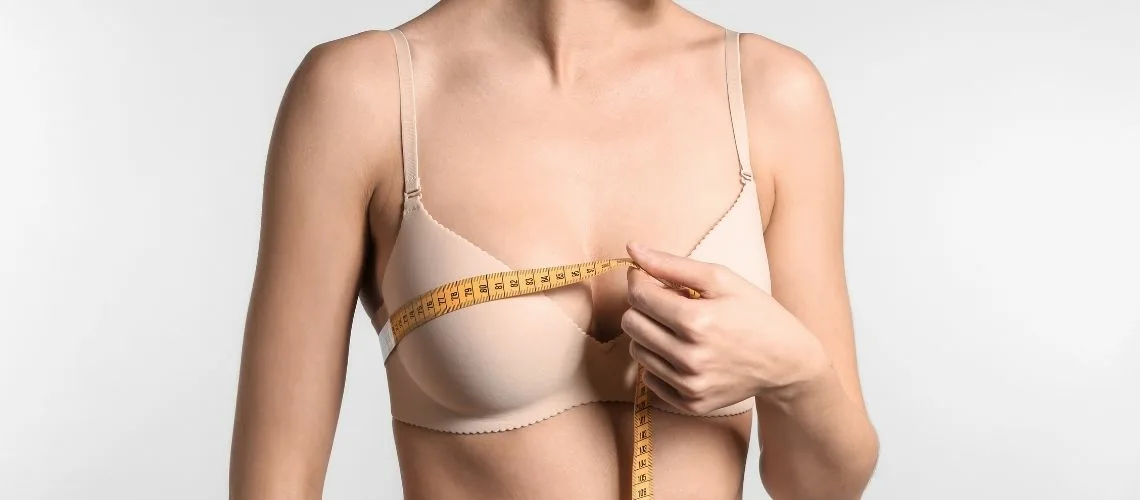
Now let’s move on to the practical part of measurement. We need two basic measurements: underbust circumference and bust circumference. Taking these measurements correctly is the foundation of determining the right bra size. Just as the strength of a building depends on its foundation, choosing the right bra depends on the precision of these two measurements.
How Is Underbust Circumference Measured?
The underbust circumference is the basic measurement that determines the band size of the bra (such as 75, 80, 85). To take this measurement, place the measuring tape under your breasts, exactly where the rib cage ends, passing just below the breast tissue. Make sure the measuring tape does not slide upward on your back and stays in a perfectly horizontal line. Do not hold the tape too tightly—adjust it so that it fits snugly against your body without preventing you from breathing. If you can insert your finger between the tape and your skin, this is the ideal tightness.
How should you breathe during measurement? You should breathe normally and comfortably. Taking a deep breath or holding your breath will cause your rib cage to expand or contract, which will not reflect your true measurement. Take the measurement after a normal exhalation, when your rib cage is in its natural state.
A single measurement may not be enough. For the most accurate result, repeat the measurement at least three times and take the average. Sometimes you may hold the measuring tape too tight or too loose on the first attempt, so repeated measurements will provide a more reliable result. If the number you obtain is not whole (for example 78.5 cm), it is generally rounded up to the next whole number.
How Is Bust Circumference Measured?
The bust circumference measurement is the second important measurement that determines the cup letter of the bra size (such as A, B, C). To take this measurement, pass the measuring tape over the fullest part of your breasts, usually at nipple level. However, every woman’s body structure is different, and the fullest point of the breast may vary from person to person. In some women, this point may be slightly above or below the nipple.
Make sure the measuring tape remains straight and horizontal. Especially on the back side, it is very important that the tape does not slide upward—this is a common mistake and leads to incorrect measurements. If you are measuring alone, it may be helpful to check the position of the tape in a full-length mirror. Hold the tape so that it lightly touches your body—not too tight and not too loose. The tape should not compress the breast tissue, but it should not leave a gap either.
What are common mistakes during measurement? The most frequent mistake is the tape being positioned unevenly, meaning at different levels in the front and back. Other common mistakes include holding the tape too tightly (which compresses the breast and reduces the measurement) or too loosely (which increases the measurement). Breathing also affects the result—if you inflate your chest by taking a deep breath, you will obtain a larger measurement than your actual size.
Different measurement techniques may be required for women with different breast structures. Especially for women with larger breasts, measuring while slightly bending forward may provide more accurate results. This position ensures that all breast tissue is included in the measurement. For sagging breasts, it is more accurate to gently lift the breasts and measure them in their natural position. Remember, the measurement should be taken in the same position in which the bra will support your breasts.
How Should Measurements Be Interpreted and How Is Size Calculated?
You have taken your measurements—so how do you turn these numbers into a meaningful bra size? At this stage, you will use your underbust and bust circumference measurements to determine both your band size and your cup size. These two values together (for example 85B) form your bra size. Like a coordinate system, these two values guide you to the correct bra.
How Is the Band Size Calculated?
The band size is obtained directly from your underbust circumference, but there are certain calculation rules. According to the system used in Turkey and Europe, you take your underbust measurement in centimeters and round it to the nearest multiple of 5. For example, if your underbust measurement is 78 cm, your band size becomes 80. If your measurement is 77 cm, it is also rounded to 80. However, a measurement of 76 cm or below is rounded to 75.
This rounding rule stems from the fact that bras are produced in specific intervals. Standard band sizes usually progress as 65, 70, 75, 80, 85, 90, 95, 100, 105, 110. However, some brands may also produce intermediate sizes (such as 82, 87), so if your measurement does not correspond exactly to a standard size, it may be helpful to try different brands.
Different countries use different sizing systems, which can be confusing, especially for those shopping abroad. While Europe uses measurements in centimeters (75, 80, 85), America uses inches and a different calculation method (32, 34, 36). The UK uses a system similar to the American one but with different calculations. In Turkey, the European system is generally used, meaning you take your measurements in centimeters and interpret them as explained above.
How Is Cup Size Determined?
Cup size is determined by the difference between the bust circumference and the underbust circumference. This difference indicates the volume of your breasts and is expressed in letters. The generally accepted standard is as follows:
- 1 cm difference: AA cup
- 2 cm difference: A cup
- 3 cm difference: B cup
- 4 cm difference: C cup
- 5 cm difference: D cup
- 6 cm difference: E cup
- 7 cm difference: F cup
- 8 cm difference: G cup
As this difference increases, the cup letter progresses in the alphabet. For example, if your underbust circumference is 75 cm and your bust circumference is 78 cm, the difference is 3 cm, which corresponds to a B cup. Therefore, your bra size would be 75B.
What about intermediate values? What should you do when your measurements are not whole numbers? For example, if the difference between your bust and underbust circumference is 3.5 cm, this falls between a B and C cup. In this case, it is recommended to try both sizes first. Depending on your body structure, breast shape, and personal comfort preferences, you can choose whichever fits better. Some brands also produce intermediate sizes referred to as “half cups” (such as B/C), which may be ideal for women with intermediate measurements.
Common Measurement Mistakes and How to Avoid Them
What are the most common mistakes made when determining bra size? First, incorrect positioning of the measuring tape. If the tape is too high during the underbust measurement, inside the breast tissue, the measurement will be smaller than it actually is. If it is too low, over the rib bones, it will appear larger than it actually is. The measuring tape should be positioned exactly under the breast tissue, aligned with the lowest point of the breastbone (sternum).
Another common mistake is using an old or stretched measuring tape. Over time, measuring tapes can stretch, especially fabric ones that may lose elasticity or become deformed with use. This leads to measurement errors. Ideally, you should check your measuring tape once a year and replace it if necessary. To check, lay the tape flat on a surface and compare it with a known length (for example, a 30 cm ruler).
Most women settle for a single measurement, but this is also a common mistake. Our bodies can change throughout the day, even within minutes. Especially breathing, posture, and even room temperature can affect measurements. Therefore, taking at least three measurements at different times and averaging them will yield much more reliable results. It is also beneficial to repeat your measurements every few months, as weight changes, hormonal fluctuations, or aging can alter your breast measurements.
Incorrect posture also causes measurement errors. A hunched posture may cause the bust circumference to be measured smaller than it actually is, while an exaggerated posture pushing the chest forward may result in larger measurements than reality. For proper posture, stand upright, position your shoulders comfortably back and down, keep your head upright, and breathe normally. You can check your posture by looking at yourself in profile in a mirror.
Finally, measuring yourself can be challenging. Keeping the tape straight on your back while reading the measurement from the front can be difficult. If possible, ask someone close to you for help. If measuring alone, use a full-length mirror to check the tape’s position, use a small clip to secure the tape, and stand close to the mirror to read the measurement. Alternatively, you can use a string or ribbon, wrap it around your body first, mark it, and then measure it on a flat surface with a measuring tape.
How Are Bra Fit Problems Solved?
You have taken the correct measurements and done your calculations, but does the bra you purchased still not feel comfortable? This is quite common and there is no need to worry. Bra fit is related not only to numerical measurements but also to your body shape, the distribution of breast tissue, and your personal comfort preferences. Just as different cuts of the same size trousers fit different body types differently, bras of the same size can also fit differently depending on the model and brand.
What Are the Most Common Fit Problems?
Straps slipping off the shoulders is one of the most frequently reported problems. This is usually caused by the band size being too large or incorrect strap adjustment. If the back of your bra rides up, this is also a sign that the band size is too large. Ideally, the bra band should sit in a straight line across your back, neither riding up nor digging into your skin. The straps should be neither too tight nor too loose—you should be able to insert your finger between the strap and your shoulder, but it should not be too loose.
Breast tissue spilling out of the cups usually indicates that the cup size is too small. If part of the breast tissue spills over the top, sides, or bottom of the cup, you should try a larger cup size. Sometimes this issue may also result from choosing the wrong model. For example, demi-cup or balconette models contain less breast tissue compared to full-coverage models and may create a feeling of overflow in some women.
The back of the bra riding up is one of the most common fit issues and generally indicates that the band size is too large. The bra band must be tight enough to support the weight of the breasts. If the band is too loose, the weight shifts to the straps and the band rides up. Ideally, the back of the bra should sit flat across the middle of your spine, aligned with the underbust. Always fasten a new bra on the loosest hook—over time, as the elasticity decreases, you can move to tighter hooks.
Underwire pressure and discomfort can be particularly annoying, especially at the end of the day. If the wires dig into the breast tissue or poke into the underarm area, this usually indicates that the cup size is too small or that you have chosen a model unsuitable for your breast shape. The wires should encircle the breast tissue, sit flat against your breastbone, and not dig into your underarm. Some women, especially those with a wider rib cage, may find wire-free models more comfortable.
How to Manage Brand and Model Differences?
Each brand has its own unique pattern and sizing standards. Therefore, someone who wears 85C in one brand may wear 80D or 85B in another. These differences vary depending on the brand’s target audience, country of production, and design philosophy. Some brands use narrower patterns, while others prefer wider ones. Similarly, cup depth may differ from brand to brand.
There are noticeable pattern differences among European, American, and Asian brands. European brands generally use narrower bands and deeper cups, while American brands prefer wider bands and shallower cups. Asian brands typically focus on smaller sizes and shape their patterns accordingly. For example, an 85C bra produced in Europe may have a narrower band and deeper cup than an American-made 85C.
Model differences also affect fit. Push-up models push the breasts upward and inward to create a fuller appearance, while balconette models leave the upper part of the breast more exposed, creating a wider neckline. Full-cup models cover the entire breast and offer maximum support. Even within the same brand, different models may fit differently, so even if you know your size, it is recommended to try each new model.
So how do you deal with these differences? First, whenever you try a new brand, in addition to your known size, try one band size up and down and one cup size up and down. The trial-and-error process is an inevitable part of finding the right bra. When shopping online, carefully review the brand’s size chart and, if possible, read customer reviews. Many customers mention in reviews whether the bra runs large or small, and this information can guide you.
Different body types suit different models. For example, balconette or demi-cup models are more suitable for widely spaced breasts, while plunge or push-up models work better for closely spaced breasts. Full-coverage and well-supported models are ideal for sagging breasts, while padded or push-up models may benefit smaller breasts. Understanding your body type and choosing models accordingly will make your bra shopping much more successful.
Remember, the right bra is not only about measurements but also about how it makes you feel. The bra that keeps you comfortable all day, supports your body, and makes you feel good is the right bra for you. Measurements are just a starting point—the true fit is about knowing your own body and discovering the products that serve it best.
When Should You Measure Again?
Our bodies are not static; they change and evolve over time. Age, weight changes, pregnancy, hormonal fluctuations, and even exercise habits can affect the size and shape of breast tissue. Therefore, measuring once is not enough. Repeating your measurements at regular intervals ensures that you choose bras suitable for your changing body. Just as you regularly check your eyeglass prescription, you should also periodically review your bra size.
What Factors Cause Size Changes?
Weight gain or loss is the most common factor directly affecting your bra size. As a general rule, a weight change of 5–7 kilograms may cause a change of one bra size. However, this change is not the same for everyone—some women notice breast growth first when gaining weight, while others gain weight in other areas and their breasts remain relatively the same. A similar situation applies to weight loss. Therefore, if you have experienced a significant weight change, you should definitely measure again.
Pregnancy and breastfeeding cause dramatic changes in the breasts. In the first trimester of pregnancy, breasts begin to grow due to hormonal effects, and the tissue becomes more sensitive and fuller. As childbirth approaches, the breasts prepare for milk production and grow even more. During breastfeeding, the breasts reach their largest size and gradually shrink as milk production decreases. It is recommended to measure once each trimester during pregnancy, after childbirth, and at the end of the breastfeeding period. During these times, choosing flexible, adjustable, and well-supported bras makes it easier to adapt to your changing body.
Aging and loss of tissue elasticity change the shape and position of the breasts over time. As age progresses, collagen and elastin fibers in the breast tissue decrease, causing sagging and volume loss. After menopause, hormonal changes also affect breast tissue, usually increasing fat tissue and decreasing glandular tissue. As a result of these changes, even if you continue to use the same band size, you may need a different cup size or a different bra model. Women over 40 are advised to check their measurements at least once a year.
Hormonal changes, especially the menstrual cycle and menopause, can temporarily or permanently affect breast tissue. During the menstrual cycle, particularly after ovulation and before menstruation, swelling and sensitivity may occur in the breasts. You do not need to buy a separate bra for these temporary changes, but you may prefer more flexible and softer models during these periods. Menopause, however, causes more permanent changes and generally requires remeasurement.
Exercise and muscle development, especially exercises that work the chest muscles, can affect the appearance and position of the breasts. Regular exercises such as push-ups and bench presses strengthen the pectoral muscles and help the breasts stand more upright. As a result of these changes, you may need bras in the same size but in different models. Additionally, women who engage in intense sports should use sports bras suitable for their activities in addition to daily bras.
Practical Shopping Tips
Now that you know your correct size, what should you pay attention to when shopping? First, prepare well before going shopping. Examine your current bras—which models feel comfortable, which are uncomfortable? Which colors and styles match your wardrobe? Wear comfortable clothes when shopping so you can easily try on bras. It may also be helpful to bring a thin T-shirt with you to test how it looks under different clothes.
Make sure you put on the bra correctly in the fitting room. First place your breasts into the cups, then put on the straps, and finally fasten the hooks at the back. After putting on the bra, lean forward to ensure your breasts are fully positioned inside the cups. Then perform the following checks: Does the band sit in a straight line across your back? Do the wires dig into breast tissue? Do your breasts spill out of the cups? Do the straps dig into your shoulders? It is not enough to rely only on size—test the bra by moving. Raise your arms, bend and straighten, sit and stand. You will perform these movements in real life, so your bra should be comfortable during all of them.
You will have different bra needs for different activities. For daily use, choose comfortable and well-supported basic models; for special occasions, more decorative and stylish models; and for sports, high-support and breathable sports bras. An ideal bra collection should include at least 3–4 daily bras, 1–2 sports bras, and 1–2 special occasion bras. This way, by rotating your bras, you both extend their lifespan and have an option suitable for every situation.
What are the features of a quality bra? Price is not always an indicator of quality, but paying attention to certain details can help you choose a quality bra. Neat and sturdy stitching, soft fabric that does not irritate the skin, well-covered wires that do not poke, adjustable straps, and at least three rows of hooks are basic features of a quality bra. It is also important that the bra maintains its elasticity and does not lose its shape after washing.
The average lifespan of a bra, depending on frequency of use and care, is 6–9 months. A regularly worn bra begins to lose its elasticity after approximately 100 washes. Signs of wear include the band losing elasticity, straps constantly slipping, fabric thinning, or wires coming out. To extend the lifespan of your bras, rotate them, wash them by hand or on a delicate cycle, never put them in the dryer, and store them flat. Storing cups folded into each other may cause them to lose their shape.
Finally, remember that finding the right bra size is sometimes a journey. Be patient and open to trying different brands and models. Every woman’s body is unique, and standard sizes may not always fit perfectly. The important thing is to find the bra that makes you feel comfortable and provides support. The right bra not only provides physical comfort but also increases your self-confidence and positively affects your body language. It is worth taking the time to give yourself this comfort and confidence.
Frequently Asked Questions
How can you accurately determine your bra size at home using simple measurements?
What is the difference between band size and cup size when choosing a bra?
Why can the same bra size fit differently across different brands and styles?
What are the most common signs that you are wearing the wrong bra size?
How often should bra size be remeasured due to body changes and aging?
Can breast augmentation or breast reduction surgery affect bra size permanently?
Why is professional bra fitting recommended even if measurements are known?
How does breast shape influence the choice of bra size and style?
Can wearing the wrong bra size affect comfort and posture over time?
What experiences do women commonly report after finding their correct bra size?

Op. Dr. Erman Ak is an internationally experienced specialist known for facial, breast, and body contouring surgeries in the field of aesthetic surgery. With his natural result–oriented surgical philosophy, modern techniques, and artistic vision, he is among the leading names in aesthetic surgery in Türkiye. A graduate of Hacettepe University Faculty of Medicine, Dr. Ak completed his residency at the Istanbul University Çapa Faculty of Medicine, Department of Plastic, Reconstructive and Aesthetic Surgery.
During his training, he received advanced microsurgery education from Prof. Dr. Fu Chan Wei at the Taiwan Chang Gung Memorial Hospital and was awarded the European Aesthetic Plastic Surgery Qualification by the European Board of Plastic Surgery (EBOPRAS). He also conducted advanced studies on facial and breast aesthetics as an ISAPS fellow at the Villa Bella Clinic (Italy) with Prof. Dr. Giovanni and Chiara Botti.
Op. Dr. Erman Ak approaches aesthetic surgery as a personalized art, tailoring each patient’s treatment according to facial proportions, skin structure, and natural aesthetic harmony. His expertise includes deep-plane face and neck lift, lip lift, buccal fat removal (bichectomy), breast augmentation and lifting, abdominoplasty, liposuction, BBL, and mommy makeover. He currently provides safe, natural, and holistic aesthetic treatments using modern techniques in his private clinic in Istanbul.