Is the Liposuction Method Alone Sufficient?
This is one of the topics our patients ask about most frequently and perhaps misunderstand the most. We often hear the question, “Doctor, wouldn’t it be enough if we just remove the fat?” Although the answer depends on the patient’s tissue characteristics, for the vast majority of patients with true gynecomastia the answer is “no”.
Liposuction, that is, the vacuum-assisted removal of fat, as the name suggests, targets only fat tissue. If the patient has pseudo-gynecomastia, meaning the problem is purely fat accumulation, liposuction is an excellent and sufficient solution. It leaves almost no scars, recovery is very quick and the result is satisfying. However, in 80–90% of gynecomastia cases, there is firm glandular tissue in addition to fat tissue:
You can think of breast gland tissue like the fibrous part inside an orange and the fat tissue like the soft layer surrounding it. With liposuction cannulas you can remove the soft fat around the “orange”, but you cannot break up and suction out that firm, fibrous central part. What happens if only liposuction is performed in a patient who has glandular tissue? The fat around it is removed, but the firm mass beneath the nipple-areola complex remains. This leads to depressions and a wavy appearance in the chest, and the nipple may still look puffy.
Situations in which liposuction alone is insufficient include:
- Presence of firm glandular tissue
- Advanced skin laxity
- Enlargement of the nipple-areola complex
- Asymmetrical breast structure
What Is the Gold Standard Combined Surgical Technique?
In gynecomastia surgery, the method by which we achieve the most aesthetic, most natural and lowest-complication results is the approach we call the “combined technique”. This method, accepted as the gold standard in both the literature and clinical practice, combines the advantages of liposuction and surgical excision (tissue removal).
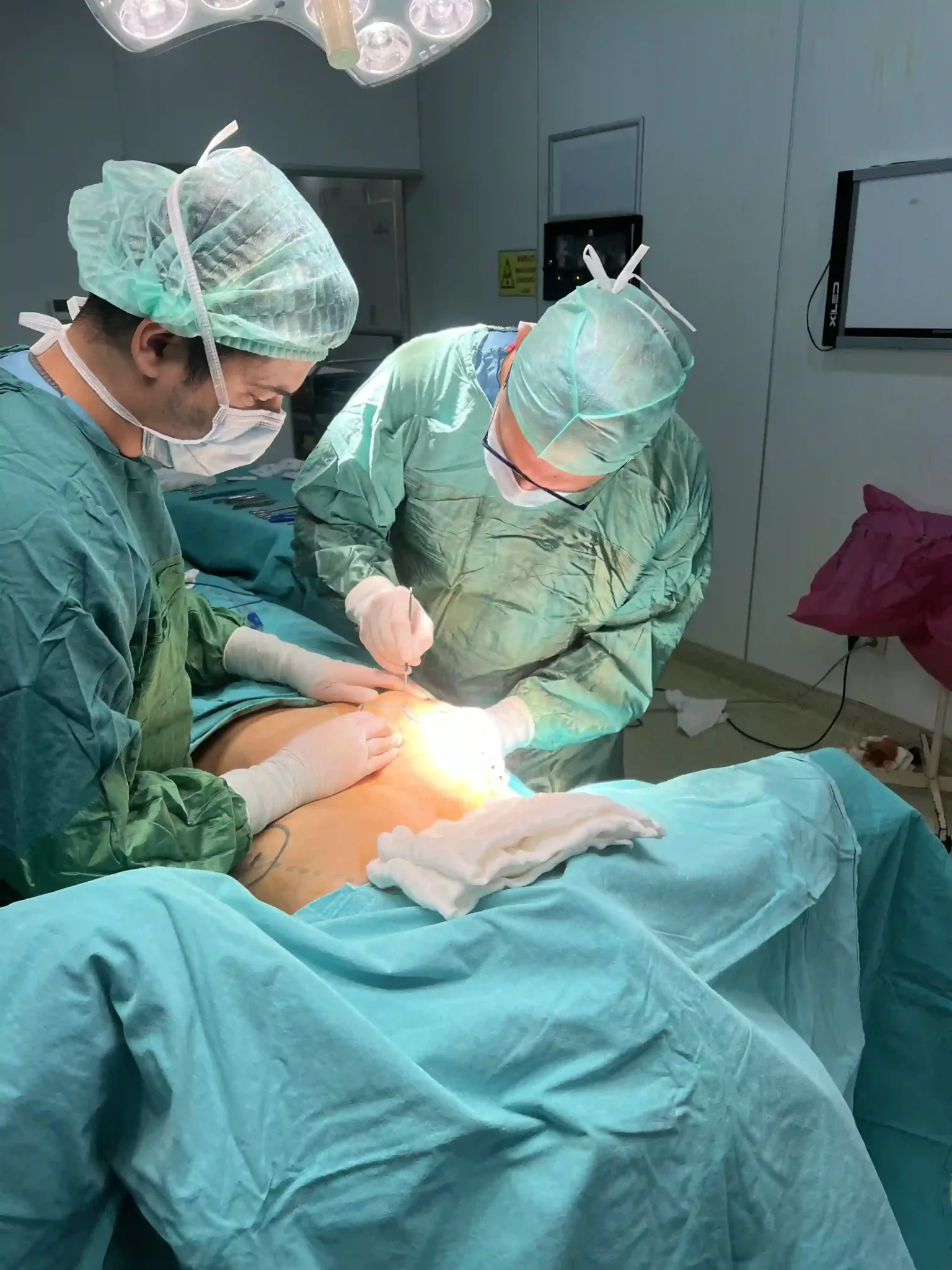
In this technique, the process proceeds as follows: first, extensive liposuction is applied to the chest area, armpit region and around the breast. This reduces the overall breast volume, reveals the outlines of the pectoral muscles and, most importantly, isolates the firm glandular tissue from the surrounding tissues. After the fat is removed with liposuction, a very small, crescent-shaped incision is made along the lower border of the nipple-areola complex to access the remaining firm glandular tissue. This tissue is then surgically removed either in one piece or in fragments.
The greatest advantage of the combined technique is that it perfectly smooths the “transition zone”. If you simply excise the glandular tissue, the area under the nipple-areola complex can collapse while the surrounding region remains raised; we call this the “saucer deformity”. However, if you first thin the surrounding area with liposuction and then remove the glandular tissue, the chest wall becomes smooth and even. The key to achieving a masculine, athletic and natural chest shape is to combine tissue removal with contouring in the same procedure.
The advantages of the combined technique include:
- Smooth chest contour
- Lower risk of bleeding
- Smaller surgical scars
- Faster recovery period
- Natural transition lines
How Does VASER Technology Make a Difference in This Process?
With advances in technology, the devices we use in plastic surgery have also evolved. One of the most powerful technologies we use in gynecomastia surgery is VASER (ultrasound-assisted liposuction). Unlike classical liposuction, VASER works by using ultrasonic sound wave energy.
The biggest contribution of this technology to gynecomastia surgery is its “selectivity”. When the VASER probe is inserted into the tissue, the sound waves it emits target only fat cells and liquefy them. They do not damage blood vessels, nerves or connective tissue. As a result, bruising and swelling after surgery are significantly less than with traditional methods. Furthermore, gynecomastia tissue is usually very firm and fibrous. VASER effectively softens this firm tissue, making the surgeon’s job easier and allowing the tissue to be removed through a much smaller opening.
Another important advantage is its effect on the skin. VASER energy heats the subcutaneous layer, triggers collagen production and promotes skin tightening. Especially in Stage 2 and borderline Stage 3 patients, we can often achieve re-draping of the skin over the chest wall using only the tightening effect of VASER, without needing to excise skin. This spares the patient from large incisions and long scars. In addition, the “high-def” style contouring – where the borders of the pectoral muscles are sharply defined for an athletic appearance – can be performed much more precisely with VASER.
The benefits of VASER technology include:
- Less bruising
- Less edema
- Skin-tightening effect
- Softening of firm tissue
- Possibility of precise contouring
Will There Be Scars and Where Are They Hidden?
In aesthetic surgery, one of our patients’ biggest concerns is understandably scars. The worry “My chest will be corrected, but will I be left with a long scar?” is often expressed. Thanks to modern surgical techniques, scars from gynecomastia surgery can be made almost invisible.
The entry point we use most often is the “periareolar” region. A crescent-shaped incision of about 1–2 cm is made along the lower border of the areola, where the colored part of the nipple meets the normal skin. Since this is already a natural transition line in color and texture, the scar blends into this boundary after healing and becomes very difficult to detect with the naked eye. The small openings used for liposuction cannulas are usually 3–4 millimeters in size and are placed in hidden areas such as the armpit crease; these typically fade completely over time.
However, we must be honest; if the patient has Stage 4 gynecomastia, meaning the breasts are extremely large and the skin is severely sagging, small incisions alone are not enough. In such cases, excess skin must also be removed, which may result in wider scars around the nipple-areola complex or sometimes extending towards the lower chest. Nevertheless, in about 90% of patients it is possible to achieve results using minimally invasive, almost scarless techniques.
Factors affecting scar visibility include:
- Patient’s skin type
- Genetic healing potential
- Smoking
- Sun exposure
- Postoperative wound care
What Is the Recovery Process Like and How Should Compression Garments Be Used?
A successful operation is only half of the journey. The other half depends on how well the patient follows the postoperative instructions. Immediately after gynecomastia surgery, we put a special medical compression garment (compression vest) on our patients. This garment is one of the most critical elements of the recovery process.
Because we remove tissue during surgery, a potential space is created between the skin and the muscle. If we do not apply pressure to this space, the body may try to fill it with serous fluid (seroma), or the skin may remain loose and heal with irregularities. The compression vest presses the skin against the underlying tissues, providing a smooth healing surface and keeping edema under control. In our standard protocol, we ask the patient to wear this vest day and night for the first 3–4 weeks (removing it only for showers), and for the following 2–3 weeks to wear it for half of each day.
To describe the recovery process more clearly: the first week is when the patient needs to rest the most. Pain is usually very mild and controlled with simple painkillers, but it is normal to have restricted arm movements. From the second week onward, the edema begins to decrease rapidly and the patient readapts fully to daily life.
Key points to pay attention to during the recovery period include:
- Regular and correct use of the compression garment
- Sleeping on the back
- Drinking plenty of water
- Limiting salt intake
- Using prescribed medications as directed
When Can You Return to Sports and Social Life?
Since most of our gynecomastia patients are young and active individuals, the timeline for returning to sports is one of the most frequently asked questions. However, returning too soon may strain the internal sutures or increase the risk of bleeding. Therefore, we implement a gradual transition plan.
If you have a desk job, you can usually return to work 3–4 days after surgery. If your job requires significant physical effort, this period may extend to 10–14 days. For returning to social life, the main determining factor is the compression garment; thanks to thin vests that are not noticeable under clothing, our patients can go out and socialize just a few days after surgery.
Regarding sports: during the first week we allow only light walking inside the home. From the second week onwards, brisk walking is permitted. In the third and fourth weeks, patients can start light lower-body exercises and workouts that do not actively strain the chest muscles. However, for weight training, push-ups, pull-ups or bench press exercises that directly work the pectoral muscles, it is essential to wait at least 6 weeks. Starting heavy exercise too early may lead to persistent edema and contour irregularities.
The general timeline for returning to sports is as follows:
- Light walking
- Brisk walking
- Lower-body exercises
- Light cardio
- Full weight-training program
What Are the Possible Risks and Complications?
As with any surgical intervention, gynecomastia surgery carries potential risks. As physicians, it is our duty to share these risks transparently with our patients. However, it should be noted that gynecomastia surgery is a procedure with a very low complication rate and very high patient satisfaction.
The most common issue we encounter is “seroma”. Seroma is the accumulation of body fluid in the surgical area. It is usually seen when compression garments are not used adequately or when the patient is overly active in the early postoperative period. In most cases, it can be treated easily in an outpatient setting by aspirating the fluid with a simple syringe and does not cause permanent problems.
Another risk is hematoma, which is the collection of blood in the surgical area. This usually occurs within the first 24 hours after the operation due to elevated blood pressure or trauma. In rare cases, it may be necessary to evacuate the accumulated blood. Apart from these, temporary loss of sensation in the nipple area, skin discoloration or contour irregularities can be seen. Sensory loss generally improves within 3–6 months as the nerves repair themselves.
Possible complications include:
- Seroma formation
- Hematoma development
- Risk of infection
- Nipple numbness
- Asymmetry
- Wound healing problems
- Persistent firmness
Are the Results Permanent and Can Gynecomastia Recur?
One of the most reassuring points for our patients when deciding to undergo surgery is that the results of this operation are permanent. In gynecomastia surgery, we physically remove the breast gland tissue from the body, so that tissue no longer has the ability to grow again. In other words, once the breast gland tissue has been surgically removed, it cannot spontaneously return to its former state.
However, we must emphasize an important point here: “weight gain”. During the operation, we do not reduce all of the fat tissue in the breast to zero; to maintain a natural appearance, we leave a thin fat layer beneath the skin. If the patient gains excessive weight after the operation (for example, an increase of 20–30 kilograms), the remaining fat cells can enlarge in volume and the chest may appear full again. This is not considered a “recurrence” of gynecomastia but rather fat accumulation due to weight gain.
An even more critical issue is the use of hormones and steroids. If the patient continues to use anabolic steroids or testosterone supplements after surgery for bodybuilding purposes, even microscopic residual breast gland cells can be stimulated to grow again. For this reason, we strongly advise our gynecomastia patients to avoid such hormonal drugs for life.
To prevent recurrence, attention should be paid to the following:
- Maintaining an ideal body weight
- Exercising regularly
- Following a balanced diet
- Avoiding steroids
- Avoiding excessive alcohol consumption

 Deutsch
 Türkçe
 Nederlands
 Français
 Svenska