How does the Extended Deep Plane Face Lift restore the neck?
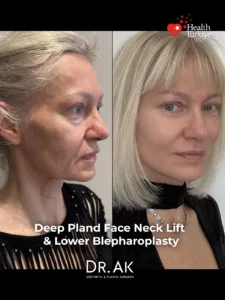
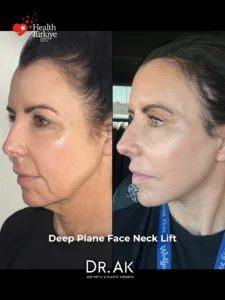
The term “extended” specifically refers to continuing the release of tissues down into the neck and jawline. This is critical because the face and neck age together. A smooth cheek looks out of place if it sits above a sagging, aged neck.
The deep plane approach allows us to separate the jawline from the neck, creating a sharp, distinct border. We address the platysma muscle, which is the thin sheet of muscle covering the neck. Over time, this muscle loosens and creates vertical bands.
In this procedure, we create a “hammock” effect. We release the platysma and anchor it upward and backward behind the ear. This tightening acts like a sling that supports the glands and deep structures under the jaw, creating a crisp right angle under the chin. For patients with a “heavy” neck, we can also perform deep neck sculpting, which involves gently reducing deep fat or reshaping the digastric muscles that contribute to bulkiness.
What is the recovery timeline for a Deep Plane Face Lift?
Recovery is a process, but it is often faster and less painful than patients anticipate. Because the technique involves less trauma to the skin itself and avoids tension, the “tight” feeling is minimal. Most of the work is done internally.
The general healing milestones are as follows:
- Day one
- Day three
- Day seven
- Day ten
- Day fourteen
- One month
- Three months
- Six months
During the first week, resting is the priority. You will likely look “puffy” rather than having a “pulled” look. By the second week, most bruising has faded enough to be covered with light makeup, and many people feel comfortable running errands or doing light desk work. By one month, the majority of the swelling has resolved, and you are largely “camera ready,” though subtle refinement continues for several months as the tissues settle completely.
Is a Deep Plane Face Lift better than fillers?
We often see patients who have spent years trying to combat gravity with injectable fillers. While fillers are excellent for minor volume adjustments, they cannot lift sagging tissue.
When you try to lift a falling face with filler, you have to inject a significant amount of product. This often leads to an “overfilled” or “pillow face” appearance, where the features look puffy and distorted rather than youthful. You are essentially adding weight to a structure that is already sliding down.
The deep plane face lift is a subtractive and repositioning procedure. We restore the natural volume of the cheek not by adding foreign material, but by moving your own falling malar fat pad back to its original high position. This restores the beautiful “Ogee curve”—the S-shaped curve of a youthful cheek—naturally.
What are the risks associated with a Deep Plane Face Lift?
Every surgical procedure carries some degree of risk, and open communication about these possibilities is essential for safety and peace of mind. Because we are working in deeper anatomical layers, detailed knowledge of the facial structures is mandatory.
Potential complications include:
- Hematoma
- Infection
- Seroma
- Nerve weakness
- Poor scarring
- Asymmetry
- Hairline distortion
- Skin healing issues
- Sensory changes
Nerve safety is a common concern. In the deep plane technique, we actually work under direct visualization. This means we can see the anatomy clearly, which allows us to safely navigate around the branches of the facial nerve. Temporary weakness can occur due to swelling, but permanent injury is exceptionally rare in the hands of a specialist.
How long do Extended Deep Plane Face Lift results last?
This is one of the most significant advantages of this technique. Because the lift is structural and does not rely on skin tension, the results are incredibly durable.
When we release the ligaments and anchor the heavy tissues to the fixed fascia of the face, we are resetting the clock. The face will not “snap back” like a rubber band. You will continue to age from this new, rejuvenated starting point.
Most patients enjoy the full benefits of the procedure for over a decade. Even fifteen years later, a patient who has undergone this surgery will look better and more refreshed than if they had never had the procedure at all. It provides a lasting foundation of youthfulness that non-surgical methods simply cannot match.
How much does a Extended Deep Plane Face Lift cost in Turkey?
An average Extended Deep Plane Face Lift cost in Turkey is 11,000 Euro.
All-Inclusive Extended Deep Plane Face Lift packages include;
- Hospital stay, 🏥
- 5-Star Hotel Stay🏨
- Transfers between the Airport, Hotel, and Hospital, 🚘
- Pre-surgery Tests & Consultations👨🔬🩸🩻
- PRIVATE Nurse during your Hospital recovery👩🏻⚕️
- Garments, Medication…📝
- And way More!!..🌟